£65.00
The Golden Egg
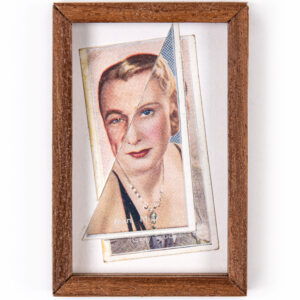
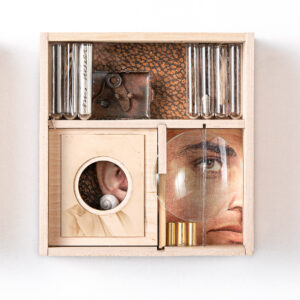
This small box construction is made from recycled walnut wood, museum glass and features a mouse skeleton, a birds skull and gold leaf. Measuring 60mm x 90mm x 32mm it exemplifies the miniature, fitting perfectly in the palm of your hand. An ideal gift for any art lover.
If you are purchasing outside of the United Kingdom email info@felixhwilkinson.co.uk for shipping prices
Description
Assemblage art for sale by Lesley Hilling
For decades Lesley has collected the detritus left by previous generations. As London undergoes a building boom she has saved the discarded wooden debris from demolished buildings and the waste from redevelopment and repurposed it. Salvaged windows, doors, lengths of architrave and timber are broken down into smaller pieces and then reworked into new forms. Some of it will remain as it is, while other pieces will be passed through the thicknesser (a giant plane), erasing it’s history and giving it a new life.
Her work explores two themes – the exterior, architectural layering of buildings and cities and the interior, more personal home space.
The pieces are made entirely from salvaged wood, built up in many layers, much of which can only be seen in glimpses. Some are constructed from old furniture, floorboards and pianos – wooden collages jigsawed and layered with an obsessive joinery. They are sculptural in their three dimensional form and painterly as each piece of wood is selected for it’s colour, texture and tonal quality. The ageing timber reminds us that people once used, worked and lived with this material.
Assemblage art for sale
She also uses softwood and plywood that is essentially the waste from building sites. With this she constructs complex, architectural work that is distilled into purely structural forms. The pieces are painted with colour or white or black or gradually shift in tone from white through grey into black. They are close knit but delicate, fragile within a grid like mesh, interconnected and interrelated they create wooden networks that viewed from a distance look like maps or aerial views of the city. They also suggest the skeleton of the city, bringing to mind the ruins of Dresden and Hiroshima. But they are not only about tracing the past life of the city, they also suggest the networks and systems around us today: the patterns of settlement and migration, the frameworks that brings us food, water and heating, The viewer is drawn to consider things we take for granted, doors, windows, walls and corners and how they are constructed. Hilling uses the methods and tools that carpenters would use when erecting a building. The pieces are constructed using halving joints – the most used assembly joint in joinery and carpentry.
The more domestic pieces have an emphasis on people, their memories, and the passage of time. They are built in a similar way to Hilling’s other work but they house tiny artefacts of memory – a photograph, a shell, a forgotten treasure, things that once had a different life. These found objects and photographs, often have magnifying glasses in front of them which distort in the same way that time distorts memories, disorienting and reorienting the viewer as they move around the piece.
Imagine lifting the roofs off a row of terrace houses or a block of flats to see how people have transformed their homes and created meaning for themselves making completely personal, an identical space. They say ‘we were here, we existed’.
For decades Lesley has collected the detritus left by previous generations. As London undergoes a building boom she has saved the discarded wooden debris from demolished buildings and the waste from redevelopment and repurposed it. Salvaged windows, doors, lengths of architrave and timber are broken down into smaller pieces and then reworked into new forms. Some of it will remain as it is, while other pieces will be passed through the thicknesser (a giant plane), erasing it’s history and giving it a new life.
Her work explores two themes – the exterior, architectural layering of buildings and cities and the interior, more personal home space.
The pieces are made entirely from salvaged wood, built up in many layers, much of which can only be seen in glimpses. Some are constructed from old furniture, floorboards and pianos – wooden collages jigsawed and layered with an obsessive joinery. They are sculptural in their three dimensional form and painterly as each piece of wood is selected for it’s colour, texture and tonal quality. The ageing timber reminds us that people once used, worked and lived with this material.
She also uses softwood and plywood that is essentially the waste from building sites. With this she constructs complex, architectural work that is distilled into purely structural forms. The pieces are painted with colour or white or black or gradually shift in tone from white through grey into black. They are close knit but delicate, fragile within a grid like mesh, interconnected and interrelated they create wooden networks that viewed from a distance look like maps or aerial views of the city. They also suggest the skeleton of the city, bringing to mind the ruins of Dresden and Hiroshima. But they are not only about tracing the past life of the city, they also suggest the networks and systems around us today: the patterns of settlement and migration, the frameworks that brings us food, water and heating, The viewer is drawn to consider things we take for granted, doors, windows, walls and corners and how they are constructed. Hilling uses the methods and tools that carpenters would use when erecting a building. The pieces are constructed using halving joints – the most used assembly joint in joinery and carpentry.
The more domestic pieces have an emphasis on people, their memories, and the passage of time. Influenced by the work of Joseph Cornel and Louise Nevelson. They are built in a similar way to Hilling’s other work but they house tiny artefacts of memory – a photograph, a shell, a forgotten treasure, things that once had a different life. These found objects and photographs, often have magnifying glasses in front of them which distort in the same way that time distorts memories, disorienting and reorienting the viewer as they move around the piece.
Imagine lifting the roofs off a row of terrace houses or a block of flats to see how people have transformed their homes and created meaning for themselves making completely personal, an identical space. They say ‘we were here, we existed’.
Assemblage art for sale.
Additional information
| Dimensions | 9.0 × 6.0 × 3.2 cm |
|---|